



































Sometimes, someone can repeatedly cross your boundaries, provoke you, hurt you, and push you further than you can handle — then the moment you finally react, the entire story suddenly becomes about you.

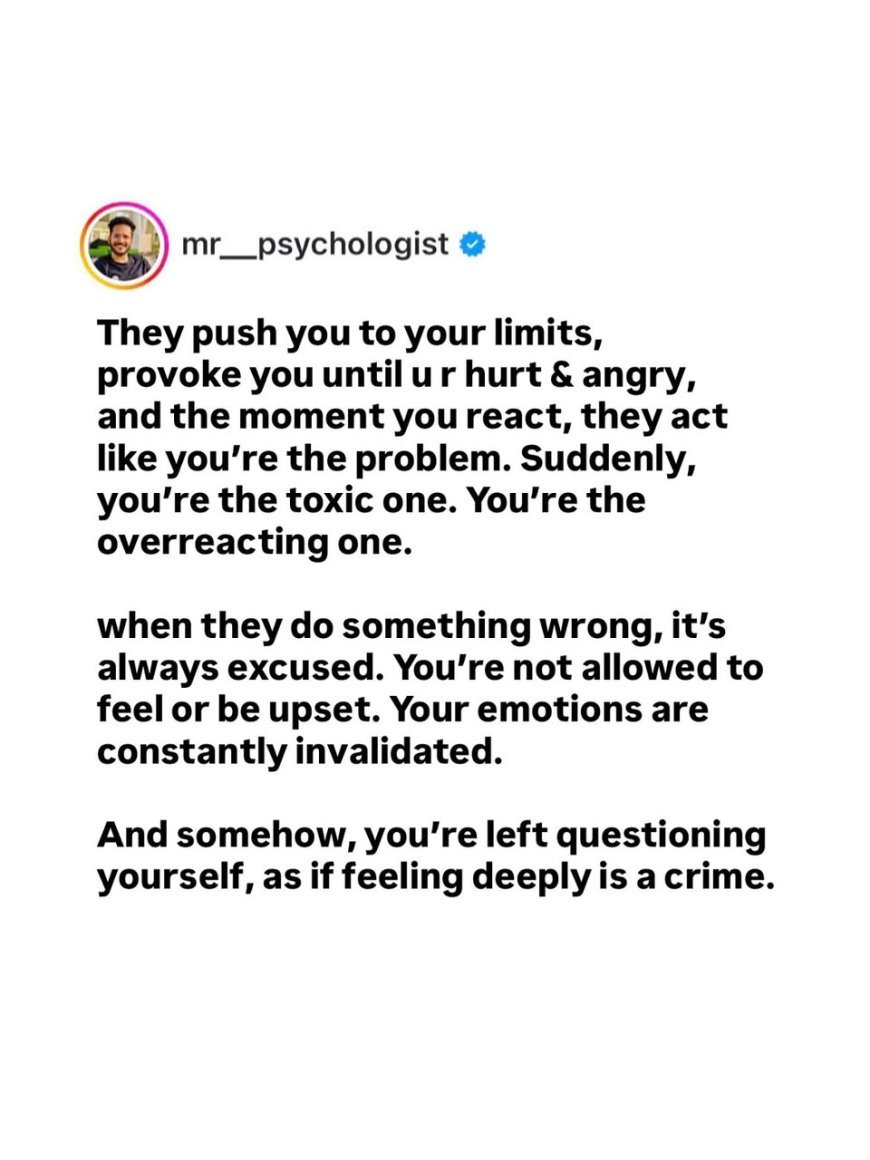
Sometimes, someone can repeatedly cross your boundaries, provoke you, hurt you, and push you further than you can handle — then the moment you finally react, the entire story suddenly becomes about you.
Suddenly, you’re “too sensitive.”
You’re “overreacting.”
You’re “always angry.”
And somehow, you become the toxic one.
This can be a form of emotional invalidation and blame-shifting. Instead of taking responsibility for what happened, the conversation gets redirected toward how you responded.
And when this happens repeatedly, you may begin questioning yourself.
You start wondering if you’re even allowed to be hurt.
You minimise your feelings.
You apologise for your reaction while the behaviour that triggered it is never addressed.
But remember this:
Taking responsibility for your reaction does not erase responsibility for what caused it.
You can acknowledge, “I shouldn’t have reacted that way,” while also saying, “What you did to me was not okay.”
Both things can be true.
You are responsible for managing your behaviour and choosing how you respond. But other people are responsible for respecting your boundaries and owning the impact of their actions.
Your emotions are not the enemy. They are signals telling you that something matters.
Listen to them. Understand them. Learn from them.
But never allow someone to convince you that having feelings is the problem.
What's Your Reaction?